
Warp-2DGS: Learnable Warped Kernels for 2D Gaussian Splatting
Published in Conference on Neural Information Processing Systems (NeurIPS), Spotlight, 2026
| NeurIPS 2026 (Spotlight) · Paper | Project page | Code | NeurIPS page | Rasterizer |
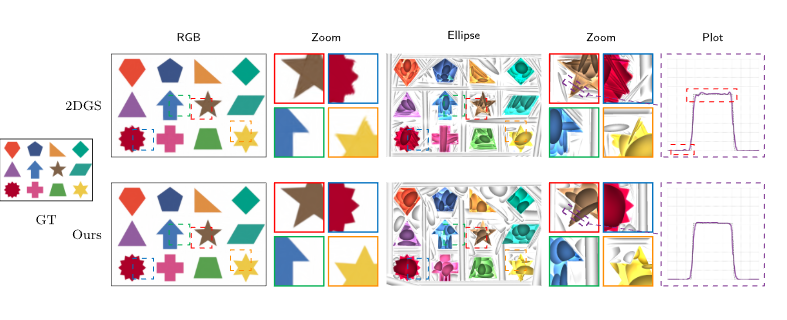
Warped kernels suppress Gibbs. Comparison between 2DGS (top) and Warp-2DGS (bottom) on a synthetic 2D scene. 2DGS suffers from Gibbs-like ringing artifacts near sharp boundaries; our warped kernels adopt a step-like edge profile that suppresses such oscillatory overshoots.
Abstract
Building upon the real-time rendering capability of 3D Gaussian Splatting (3DGS), 2D Gaussian Splatting (2DGS) achieves improved surface reconstruction and geometric fidelity for novel view synthesis through explicit planar Gaussian primitives. However, the smooth falloff inherent to Gaussian kernels fundamentally limits the reconstruction of high-frequency shape signals, causing over-smoothed edges and loss of fine geometric detail. Prior works have explored alternative kernel functions to address this limitation, yet through systematic evaluation across signal fitting tasks, we find that all existing kernels suffer from the Gibbs phenomenon — producing oscillatory artifacts near sharp discontinuities. This observation motivates a fundamentally different strategy: rather than replacing the kernel, we make it deformable. This study presents Warp-2DGS, which augments each Gaussian surfel with a learnable, monotonic coordinate remapping in its local tangent plane. With only one free control point per axis (two parameters per axis, four per primitive), the remapping enables asymmetric radial profiles, allowing each primitive to reliably capture sharp edges and irregular structures that symmetric kernels inherently cannot represent. The deformation operates on the 2D tangent plane of 2DGS, preserving the differentiable rasterization pipeline with moderate training overhead, and is optimized end-to-end through rendering loss alone. Experiments on MipNeRF 360 and Tanks & Temples demonstrate that our method effectively suppresses Gibbs artifacts at sharp boundaries and achieves the best PSNR among 2DGS-based approaches, with consistent gains over 2DGS in PSNR, SSIM, and LPIPS.